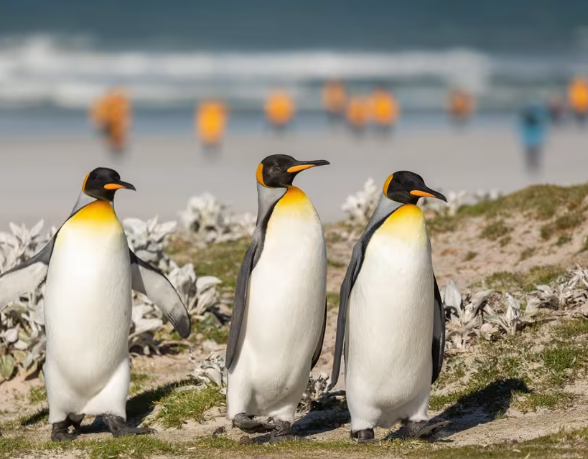
King penguins are magnificent creatures, famous for their striking colors and social behaviors. Found mainly on remote islands in the Southern Hemisphere, these birds lead fascinating lives within their colonies. Their upright posture, vivid markings, and dense group formations have also inspired wildlife art and public installations, where a penguin sculpture can symbolize resilience, community, and the charm of polar and subantarctic life. In this post, we’ll explore the unique aspects of their colony life, from their breeding rituals to their social structure.
Breeding Rituals of King Penguins
The breeding cycle of king penguins begins with elaborate courtship displays. Males attract females through a series of vocal calls and physical movements, including head bobbing and flippers waving. Once a pair has formed, they engage in a bonding process that may last several weeks. During this time, they share mutual preening and displaying trust towards each other, which is essential for their later parenting duties.
After establishing their bond, female king penguins lay a single egg, which both parents take turns incubating for about 54 to 60 days. This shared responsibility strengthens their bond and teaches them valuable skills for raising their chick. After hatching, the chick relies heavily on its parents for warmth and food in the harsh island conditions. A penguin sculpture showing a pair with a chick can visually express this strong family bond and the cooperative nature of penguin parenting.
- Observe and learn about the mating dances during breeding season.
- Respect the nesting areas to avoid disturbing the breeding pairs.
- Research the incubation time to better understand their life cycle.
- Keep a safe distance from the penguins to minimize stress on the birds.
The Social Structure of King Penguins
King penguins thrive in social environments, and their colonies can contain thousands of individuals. Within these colonies, they establish a hierarchy influenced by factors such as age and experience. Older, more experienced penguins tend to assert dominance over younger ones, often guiding them through the challenges faced in the wild. This social dynamic helps in resource sharing and communal decision-making like foraging and relocation when necessary.
Communication among king penguins is exceptionally rich; they utilize a variety of vocalizations to strengthen social bonds, warn of threats, or signal distress. The youngsters learn these calls as they grow, reinforcing their ties within the colony. Moreover, the collective nature of their social behavior allows them to participate in what is known as “crèche” behavior, where chicks gather in groups for mutual protection. In zoos, aquariums, and educational spaces, a penguin sculpture arranged as a small colony can help visitors understand the importance of social life and group protection among these birds.
- Foster an understanding of the social dynamics by observing interactions in colonies.
- Note the calls and sounds made by different individuals for a deeper connection.
- Encourage awareness of the importance of community in their survival.
- Document behaviors, especially in younger penguins as they adapt socially.
Survival Challenges in a Remote Environment
Living in remote islands, king penguins face a myriad of survival challenges, including extreme weather conditions and limited food resources. The harsh, often icy environment requires them to adapt quickly; their thick layers of insulation help them withstand freezing temperatures. Additionally, they need to travel considerable distances to find food, primarily relying on fish and squid in cold ocean waters, which may not always be readily available.
Climate change poses significant threats to their habitat as rising sea levels and temperature fluctuations disrupt their breeding and feeding grounds. Moreover, the increased frequency of storms can lead to habitat loss and more challenging conditions for raising chicks, making their survival more precarious than ever. As such, studying these challenges can provide insights into the effects of climate change on vulnerable species. A penguin sculpture in a conservation center or coastal park can serve as a visual reminder of the fragile environments these birds depend on and the need to protect them.
- Monitor changes in weather patterns in regions where king penguins live.
- Support conservation efforts aimed at protecting their habitats.
- Educate others about the impact of climate change on wildlife.
- Participate in citizen science projects focusing on seabird populations.
Foraging and Feeding Habits
King penguins are remarkable foragers, often diving to great depths in search of food. They can dive as deep as 300 meters and stay underwater for over 2 minutes. This exceptional ability allows them to access food sources that are not available to other predators. Their diet mainly consists of fish, cephalopods, and crustaceans, and they rely on their acute vision and swimming prowess to navigate underwater.
To ensure a successful hunt, king penguins often dive in groups, which helps them locate schools of fish more efficiently. Their foraging strategy includes a technique known as “predation dives,” where they use their agility to catch fast-moving prey. Once they return to the colony, they may regurgitate food to feed their chicks, showcasing not only their hunting skills but also their caregiving abilities. A dynamic penguin sculpture with streamlined forms or swimming-inspired poses can reflect this hidden underwater world that is essential to their survival.
- Observe their diving behavior to understand their foraging methods.
- Learn about the types of food that sustain them through different seasons.
- Respect their feeding zones to avoid interfering with their hunting.
- Document the prey caught and the techniques used for educational purposes.
The complex and fascinating life of king penguins on remote islands showcases the intricate balance of nature. By understanding their breeding behaviors, social structures, survival challenges, and feeding habits, we gain deeper insights into their world. Remember to support their conservation and share knowledge about these extraordinary birds as they face the challenges of modern life. Whether through wildlife observation, educational programs, or the symbolic presence of a penguin sculpture in a public or natural space, king penguins continue to inspire appreciation for resilience, family, and life in extreme environments.