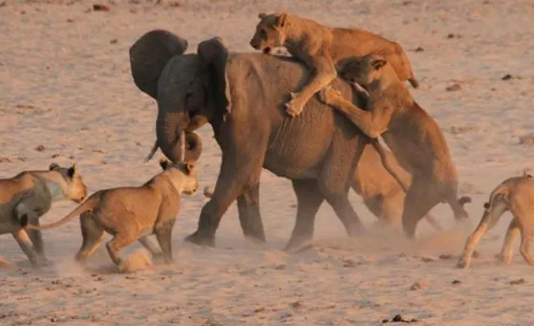
In the wild, survival often depends on coordination, awareness, and collective defense. Elephants, as some of the largest and most intelligent land animals, demonstrate highly organized group strategies when facing predators such as lions. These behaviors reveal the strength of their social bonds and the importance of cooperation within the herd.
1. Social Structure and Communication
Elephants live in matriarchal herds, typically led by an experienced older female. This leadership structure is critical when danger appears. If a lion is detected, the matriarch and other adults respond quickly, using vocalizations, body language, and movement cues to alert the herd.
Elephants can also communicate through low-frequency sounds that travel long distances, helping them coordinate with members beyond immediate visual range. This communication strengthens herd cohesion and ensures that calves and vulnerable members receive protection.
- Learn to recognize elephant vocalizations and body signals
- Observe how herds respond to possible threats
- Understand the importance of hierarchy in group behavior
- Apply clear communication principles in team settings
2. Forming a Defensive Circle
One of the most effective elephant defense tactics is forming a protective circle around calves. When lions approach, adult elephants gather tightly, placing younger members in the center while larger adults face outward toward the threat.
This formation makes it difficult for predators to isolate a weak or young elephant. Adults may trumpet, spread their ears, display tusks, or step forward aggressively to intimidate the lions. In many cases, this coordinated display is enough to discourage an attack.
- Practice coordinated group positioning in team activities
- Assign roles based on strengths and experience
- Improve situational awareness during challenges
- Encourage mutual protection and cooperation
3. Using Size and Strength to Their Advantage
Elephants possess immense physical strength, making them dangerous opponents for predators. Adult elephants can deter lions through charging, stomping, tusk displays, and loud vocal warnings. Their size alone often makes predators reconsider an attack, especially when the herd is united.
Rather than relying only on individual strength, elephants combine physical power with group strategy. This makes their defense especially effective, as lions are less likely to risk injury when facing multiple coordinated adults.
- Recognize the value of individual strengths within a group
- Use collective power to manage difficult situations
- Develop both confidence and restraint under pressure
- Support others by contributing your strongest abilities
4. Training Young Elephants in Defense
Young elephants learn defensive behavior through observation and participation. Calves watch how adults respond to danger, how they form protective structures, and how they interpret warning signals from the herd.
This learning process prepares younger elephants to react appropriately as they mature. Through repeated exposure, they develop survival skills that will later help them protect themselves and future herd members.
- Encourage hands-on learning and observation
- Model protective and responsible behavior
- Build resilience through guided experience
- Teach younger members how to respond under pressure
Elephants’ group defense strategies against lions highlight their intelligence, social organization, and deep commitment to protecting one another. Their ability to communicate, cooperate, and teach younger generations shows how survival in the wild often depends on unity as much as strength.
In conservation centers or educational spaces, an elephant sculpture can symbolize this remarkable combination of power, wisdom, and collective protection, reminding visitors of the extraordinary social lives of these majestic animals.