Elephants are among the most intelligent and socially complex animals on Earth. As water scarcity intensifies due to climate change and human expansion, they demonstrate a combination of behavioral, physiological, and social adaptations that allow them to survive in increasingly harsh environments.
1. Behavioral Adaptations
One of the most observable responses to diminishing water sources is a shift in elephant movement patterns. Elephants are known to travel long distances—sometimes up to 60 miles—in search of reliable water. These journeys rely heavily on memory, as older elephants, especially matriarchs, retain knowledge of seasonal water locations.
During drought conditions, elephants also strengthen their social coordination. Herds become more cohesive, sharing information and resources. Younger elephants benefit from the experience of older members, which increases overall survival rates. This collective intelligence is a defining trait of elephant societies.
In many cultures, the strength and unity of elephant herds are symbolized through art, such as an elephant statue, representing memory, resilience, and continuity—qualities that are clearly reflected in their real-life survival strategies.
Ways to support:
- Track migration data through conservation groups
- Protect natural corridors and water access routes
- Promote awareness of elephant habitat needs
- Participate in citizen science monitoring programs
2. Physiological Adaptations
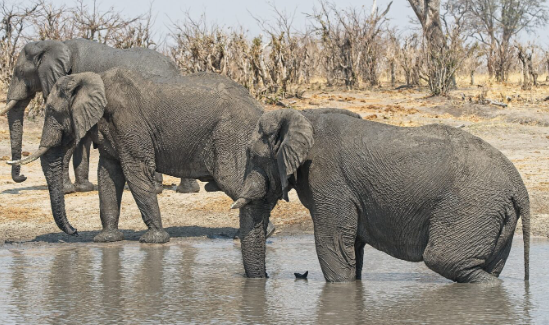
Elephants also rely on physical adaptations to cope with water scarcity. Their large body mass reduces the relative rate of water loss, while their thick, wrinkled skin helps retain moisture. Mud bathing is another essential behavior—it acts as both sun protection and a moisture barrier.
In extreme conditions, elephants can regulate their internal systems to conserve water. They are capable of reducing metabolic activity and producing more concentrated urine, minimizing fluid loss. These physiological mechanisms are critical for enduring prolonged dry periods.
Key actions:
- Support scientific research on wildlife adaptation
- Learn about cross-species survival strategies
- Stay informed on environmental water issues
- Contribute to habitat restoration initiatives
3. Community Engagement and Conservation Efforts
Long-term elephant survival depends not only on biology but also on human cooperation. Conservation programs that involve local communities have proven highly effective. When people understand the ecological importance of elephants, they are more likely to adopt sustainable practices that protect shared resources.
Educational outreach, economic incentives, and collaborative planning all contribute to better water management and habitat preservation. Communities that actively participate in conservation efforts often see improved outcomes for both wildlife and human livelihoods.
How to get involved:
- Join local or global wildlife conservation organizations
- Attend sustainability workshops or training sessions
- Advocate for environmental education in schools
- Organize or support community conservation events
Conclusion
Elephants exhibit remarkable resilience in the face of shrinking water resources, combining intelligence, cooperation, and biological adaptation to survive. However, their future depends on a balance between natural adaptability and human responsibility. By supporting conservation efforts and promoting sustainable practices, we can help ensure that these extraordinary animals continue to thrive in a changing world.